
By Dan Shine
Voice Columnist
Water Street
In 1638, the first white settlers entered what they would call the West Side by fording what would become the West River: To this day, an artist’s mural depiction of this event remains on the wall of the Post Office on Campbell Avenue.
In the years that followed, a farming community would develop along an area that would eventually become known as West Haven, Borough of Orange, and later the Town of West Haven, and still later, The City of West Haven.
In 1869, the original Kimberly Avenue Bridge was built across the mouth of the West River to accommodate a horse railway: This facilitated transit and commerce between New Haven and West Haven. And here begins our story.


Right — A view of Main Street turning into Water Street, the Gesner & Mar shipyard.
Today, not far from the Kimberly Avenue Bridge, there stands a deserted area surrounded by chain link fences: While now that land is nothing but an expansive weed-grown lot, for decades and generations it was a magnet for West Haven’s commerce and skilled labor. The streets involved were First Avenue, Water Street, Elm Street, Main Street and Richards Place.
So, what were those factories and shops, where skilled hands worked diligently for so many years, and what did they produce? Well, it’s like this…
Charles E. Graham was the only surviving son of James Graham, who was active in Connecticut politics and made his fortune in manufacturing. The family once owned a large portion of Kelsey Hill, and indeed, Graham Manor Road is named for them.
Charles Graham was one of the founders of the West Haven Manufacturing Company, located in a brick building at the corner of Elm Street and Water Street. It was there that they produced hacksaw blades and power-driven hacksaw machines. The company employed a workforce of 200 up until 1920, when it was bought out by the Miller’s Falls Company and relocated away from West Haven. That factory building remained standing until just a few years ago.
Just across Water Street stood the Advance Doll and Toy Company, founded by John Ardolino, and which was active during the 1950s and 60s, with 160 employees producing imaginative, revolutionary dolls named Walking Wanda and Talking Winnie. These dolls were very popular, but eventually, mass-produced, more sophisticated competition brought about the end of Advance Doll and Toy Company in the late 1960s.
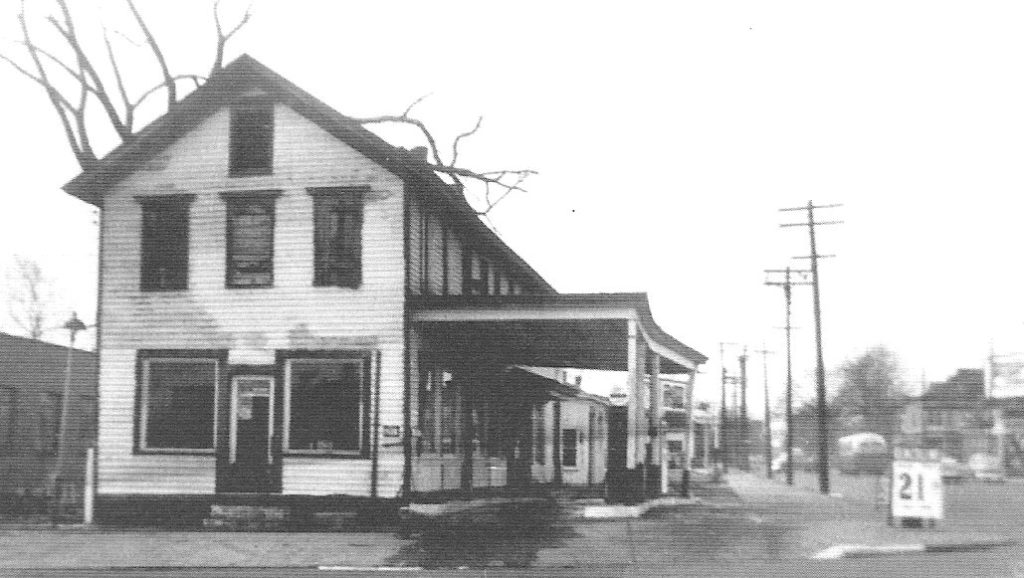
Next door to Advance Doll and Toy Company and for decades was Earl Scheib, Inc., home of the $29.95 automobile paint job. The sign on their building remained long after the company had moved on.
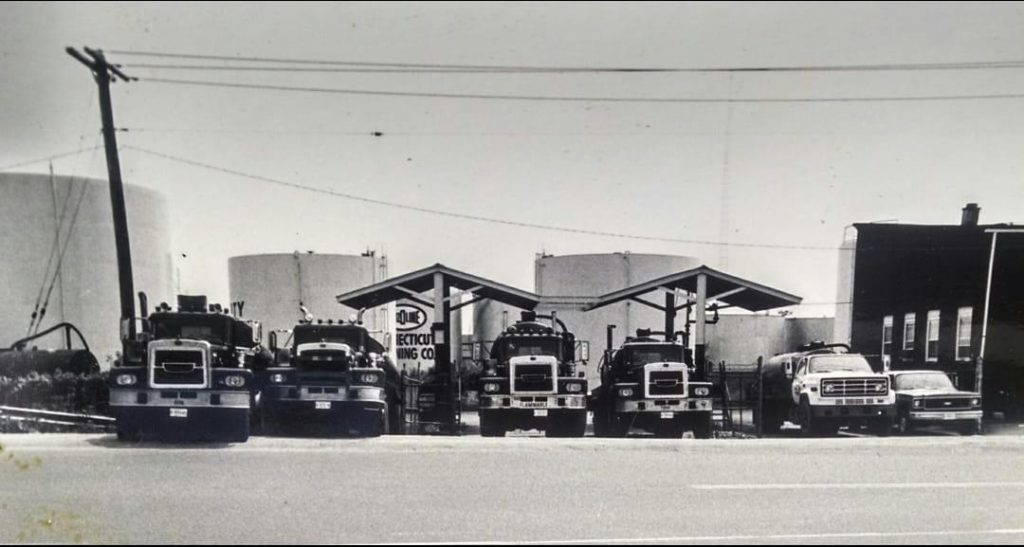
Immediately adjacent to Kimberly Avenue Bridge was once located Connecticut Refining/Benzoline, which provided heating oil to local homes and businesses.
It is difficult for us in these times to imagine a day when workmen walked off to their tasks each morning, over the dirt streets of West Haven; there they performed their labors in a place where great wooden ships with hundred-foot masts towered over nearby homes, and much of the community relied on the sea for its livelihood.
At the far end of Water Street, where it intersects Main Street, there was Gesner and Mar Shipyard, which operated two shipways from 1861-1891, and which at the time was the most important industry in town. There they built three and four-masted schooners, as well as steamships. So closely did our community identify with the sea during that period that the tall flagpole on the Green was actually a mast and spar that was removed from a ship that was being overhauled in the shipyard.
In later years, the shipyard was taken over by Ruben Green and called Green’s Shipyard. When that business failed, the Yale Flying-Boat Service took over the site in the 1920s and engaged in the construction and repair of seaplanes. In the 1930s and 1940s, the business on that site was known as West Haven Shipyard, Inc. Today, along the water’s edge, a row of rotting pilings bears mute testimony to an industry that once was.
In 1849 Henry Richards opened his own business on Water Street, operating a coal and lumber yard known as the H.H. Richards Company. Their advertisements proudly stated that H.H. Richards sold “pine, spruce and hemlock timber, plank boards, clapboards, shingles, pickets, laths, worked and dressed lumber.” That business would continue until 1939, when the buildings and lumber yard were consumed by fire.
During that period, Henry Richards was a leader in the community, establishing the Republican Party, and serving as an advocate of the Abolitionist movement.
In those days, typically those who owned and operated businesses in West Haven made their homes in West Haven as well. The Richards family adhered to that principle. In fact, today you can still see “Harborview,” the home of Benjamin F. Richards at 65 Main Street, corner of First Avenue. Built in 1892 for his bride, it was a showpiece of that age, with custom trim and cabinetry which used the finest woods, similar to those on the better sailing ships of that era. It should be noted that Benjamin Richards had by then branched out into the sale of insurance, real estate, “modern built houses,” and “a fine list of rents for prompt paying tenants.” That home, also a showpiece in itself, was designated a “Historical Treasure of West Haven” by the West Haven Historical Society in 2018.
George W. Lyons, Sr. was born in New Haven in 1894 and initially received formal education only up through the eighth grade. Following that, he worked as an apprentice in an iron and steel mill. He was then able to resume his education through evening courses at Yale Business School; in addition, he took correspondence courses in engineering. Whether he knew it or not, he was laying the foundation for what would be his great success.
In the mid-1920s, after gaining considerable experience in the architectural iron business, Lyons decided to go into business for himself, for he had recognized an unfulfilled opportunity that he was prepared and equipped to capitalize on: The wooden basement entrance to his house was peeling and rotting and continually in need of maintenance and repair. What could he do to solve this problem and make a living from the solution? After experimenting with a braking press, welding torch and some twelve-gauge sheet steel, he had produced a prototype of the metal outside basement door which is so commonplace today! As a direct result the Bilco Company was incorporated in 1926 and production began immediately.
During the Great Depression, Bilco’s workforce was reduced to only include Lyons and his two sons. In that period of semi-idleness, product improvements were developed: Lyons added and patented safety devices and improved the overall sophistication of the door design itself. Also, by design, Bilco doors were intended to be installed by contractors or even by the home handyman, and this strengthened their position in the market. By now, imitators had come along to provide “me-too” products, but they could not compare with the more advanced Bilco products—thus Bilco maintained their products’ position as leader in their field.
As World War II drew to a close, Bilco realized significant growth and outgrew their New Haven location. Thus, in 1953, Bilco moved into a new, much larger manufacturing facility at Water Street in West Haven. That building, formerly owned by the defunct Steelcraft Power Boats offered five times the previous floor space available to Bilco and promised to be Bilco’s for many years to come.
Bilco remained a family operation for decades, and today has relocated back to New Haven, after a stay in West Haven totaling 62 years. During that period, many West Haven families found their employment and livelihood within the walls of The Bilco Company.
Hallock’s is a long-established name in West Haven’s business history, with roots tracing back to the H.P. Hallock Company, which was established as a manufacturer in 1940 with its principal office at 30 Water Street. Later, Hallock’s operated as an appliance store at 1 Main Street. That business was in operation there until the redevelopment of that neighborhood began.
Near the northwest corner of the currently vacant lot, there once stood Nick’s Diner, which was a West Haven favorite for many years. That building was razed as part of the redevelopment project, and Nick’s moved to a location on Sawmill Road, much to their great success.
Today, all is quiet where once stood a multitude of West Haven businesses and homes. It is our sincere hope that one day, West Haven will restore this very visible area to its once-vibrant and successful status!