By Dan Shine
Voice Columnist
Savin Rock’s Transition
Part I
See part 2
Note: Later this month, Steve Hildrich will be gifting the City of West Haven with a very large and detailed compendium of articles, letters and other documents which will chronicle the transformation of Savin Rock after its aging amusement park was torn down. It especially includes the 40-year struggle against Redevelopment that resulted in the lovely parks which have been open to citizens and visitors for decades. A summary of the whole period, like “Savin Rock in Transition,” is also included.
—–

Those of us of a certain age have fond and romanticized memories of Old Savin Rock. It was a wonderful, magical place, and maybe it could have been rehabilitated and retained, but this was not to be.
The Boy can still recall the magic of the Rock; but he can also recall a Savin Rock of broken sidewalks, broken glass, weeds, bums and poor sanitation. And he remembers Saturday and Sunday mornings on Kelsey Avenue during the warmer months, when he and father would have the regular task of picking up garbage, leftover food and drink containers, and other assorted objects which had been flung from car windows, and onto their lawn, as the evening’s revelers drove home. Dinnertime talk became more and more frequent as to “what should be done” about all of this.
Apparently, they weren’t alone–West Haven taxpayers expressed their will by referendum in 1963, and in 1967 the various structures of Old Savin Rock were demolished, one-by-one.
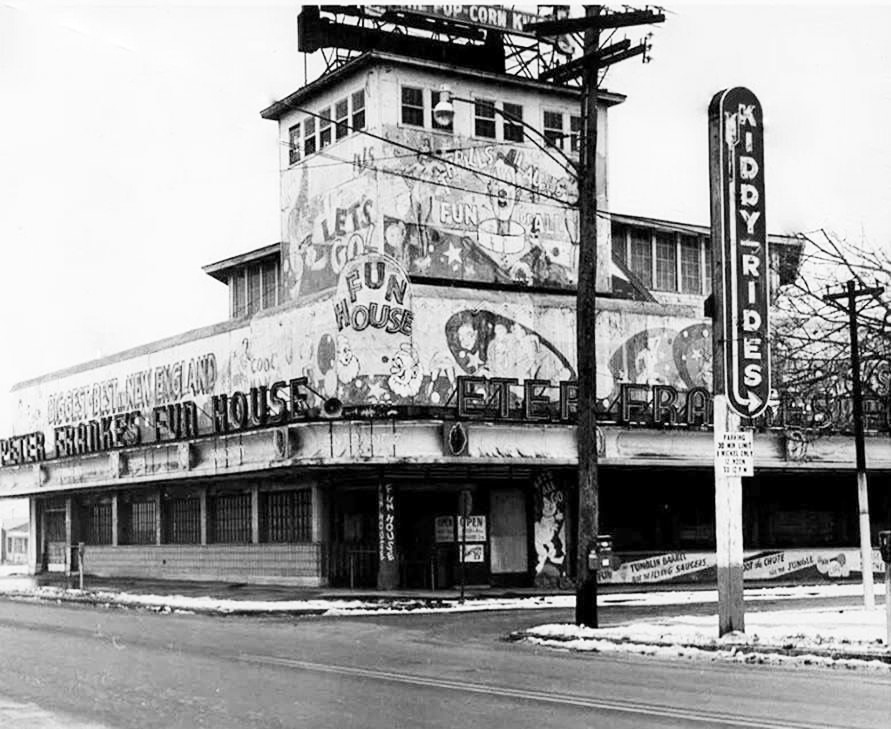
By 1967, most of the structures and attractions at Savin Rock had been removed, although The Boy remembers that some remained until 1969 or so: Peter Franke’s, the Flying Horses, the Skooter Cars, and George Kelsey’s old Bandstand, which would eventually collapse before it could be rehabilitated, a victim of age and the elements.
But without a doubt, the wheels of Progress were turning even before the demolition took place. In 1968, a redevelopment plan was approved.
The various sentiments of the period were summarized in the words of past West Haven Historian, the late Harriet C. North, as written in 1986: “However, a new era in history of Savin Rock and the City was already well under way by 1973. The final demise of the Savin Rock amusement area in the late 50’s and early 60’s helped trigger a massive Redevelopment effort, and at one time plans for scores of apartments were proposed…”
The following is presented as submitted by Steve Hildrich from news clippings and his personal recollections:
Changes in public attitudes emerged. The initial plan was to retain four acres adjacent to the Rock as open space. In 1971, Bernie Kershner formed a concerned citizens group to save six acres instead. Others wanted more.
The dramatic shift took place in 1973 when Summersetts’s proposal for an 800’ long 12 story high apartment on Parcel I, which was dubbed “the Great Wall of China” set off a massive petition drive by an organization called “Save Our Shore” (SOS), formed by people like Jean Kaas of the First Congregational Church. The SOS founders’ names are immortalized on the stone plaque at the center of the beautiful “Grove Park,” formally known as Parcel I.
SOS called for a 1973 referendum that put a stop for a time to the Great Wall. By late 1973 SOS evolved into IMPACT (both a civic group and a political party) which ran Ted Adams unsuccessfully for Mayor. IMPACT organized another petition for a 1974 referendum to stop all further development on the remaining 40 acres. Although they won the referendum about 6,400 to 4,900, the many “no” votes may have shown the public’s awareness that stopping all development might be a problem.
However, much of West Haven was stunned when the Connecticut Supreme Court on Jan.4, 1978, overturned the result of the 1974 referendum. The court stated, in essence, that for any significant change in a redevelopment plan, all the original developers, or their successors in interest, would have to agree to the change. The Court also held that a 40 acre park would be a “significant” change in the plan. The policy justification was that to get developers to commit their money to a redevelopment plan, they had the right to not have the rug pulled out from under their expectation of return on investment when they committed to the original plan.
To be continued.