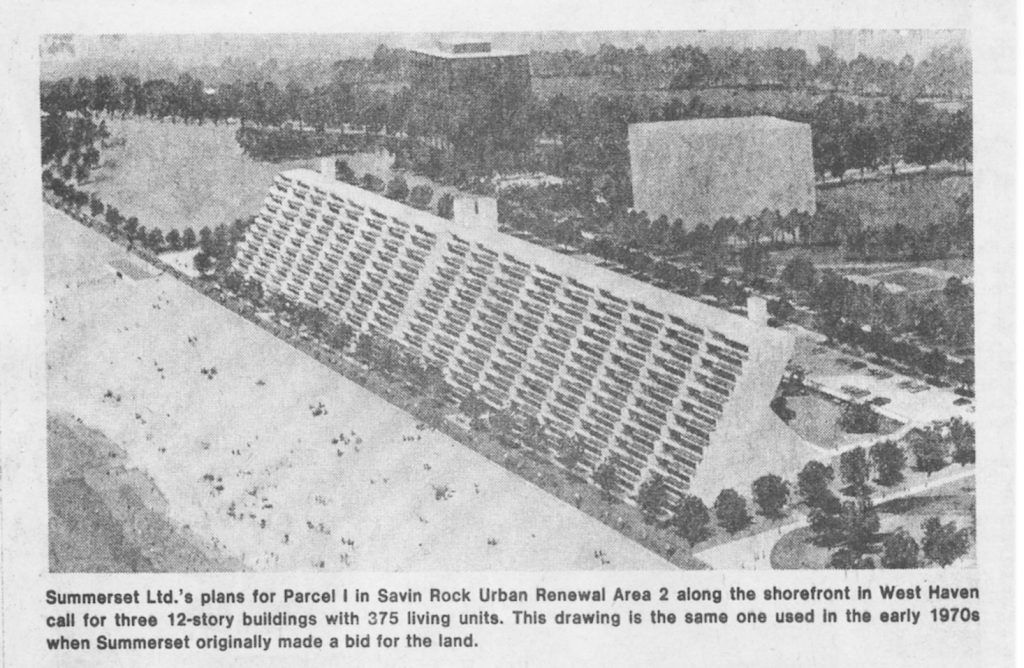
Right –An artist’s rendering is shown of the Summerset Ltd. concept of the 12-story condominium constructions that were to dominate the shorefront redevelopment plan. The plan would have restricted much of the area leading to Savin Rock from public use. The plan stirred controversy that lasted two decades.
By Dan Shine
Voice Columnist
Savin Rock’s Transition
Part II
See part 1
Note: Steve Hildrich is gifting the City of West Haven with several copies of a very large and detailed compendium of articles, letters and other documents which chronicle the transformation of Savin Rock after its aging amusement park was torn down. It especially includes the 40-year struggle against Redevelopment that resulted in the lovely parks which have been open to citizens and visitors for decades. A summary of the whole period, like “Savin Rock in Transition,” is also included: A copy is available for research and review at West Haven Public Library.
During 1978, Mayor Robert Johnson tried to get the developers to agree to his “Compromise Plan” to save 25 acres. To some he seemed to betray his commitment to save the 40 acres, but he did not. The Supreme Court had to be obeyed.
By early Januarys c 1979, the Harbor Mist Restaurant, successor to Phyllis’s, said “no” to any compromise. The other 6 developers agreed to the compromise. Mayor Johnson declared a “development deadline” of Feb. 5, 1979, the next Redevelopment Agency meeting.
Inspired by a friend, Steve Hildrich with Rev. Ernest Bodenweber of the ”Earth Stewardship” of the First Congregational Church formed a coalition with Tom Gallagher and the Jaycees and Carol and Bob Altvater and the West Shore Garden Club. IMPACT was invited but did not partake. Called the Concerned Citizens for Bradley Point, they petitioned, not the City, but a private restaurant, Harbor Mist (previously Phyllis’s and later the Casino). They gathered 1,600 signatures in four days, and presented their petition to the owners Sainis and Lazaris on Saturday. When resisted, Hildrich said, “I doubt your 1,600 customers will be happy to learn you refused to receive their representatives.” The owners agreed to talk with Hildrich and Gallagher, and finally they agreed to compromise if they could get something in return. Billy Riccio of the West Haven News was there when the four came out and announced their compromise.
Two days later the Redevelopment Agency meeting was raucous. Finally, Mayor Johnson realized there was a basis for compromise, and asked the Agency extend the deadline to March and it voted to do so. Two more postponements of development finally led the Compromise Plan being signed in May 17, 1979. A 20 acre Bradley Point Park was to be created (including separated Parcel J2).
As part of the compromise, Harbor Mist got a “right of first refusal” on Parcel M, meaning they could develop the property between the Rock and Capt. Thomas Blvd. (where kites fly today). However, Hildrich, who participated in negotiations, got included wording that said whatever was built on Parcel M “could not obscure the view of Savin Rock from Capt. Thomas Blvd.”
This was key to a 1988 Superior Court decision in which Harbor Mist and the Casino received $0 in their suit for damages, upholding the City (and Agency) decision to stop the 12 story high rise development on Parcel M because it “obscured the view of Savin Rock.” (Jimmies v. West Haven, et al., Dorsey, J. 7-12-1988, pp. 23-24, 28)
IMPACT had opposed the Compromise Plan of 1979, calling it a “fraud” (Journal-Courier, 5-22-79, p.12), insisting they wanted all 40 acres then and there, ignoring that the Supreme Court had given the developers the right to agree to any significant change. The Concerned Citizens for Bradley Point wanted 40 acres of park, too, but realized that the Compromise was the best possibility at the time: 20 ACRES WAS BETTER THAN NOTHING. IMPACT continued to resist the Compromise. Finally in the Nov. 20, 1980, issue, the “West Haven News” admitted that the Compromise was better than nothing and supported the Plan.
Attorney Brian Fisher (later Judge) chaired the committee that got public input into what kind of park they wanted and oversaw the planning. The city succeeded in securing Federal funds for walkways, lighting, landscaping, parking, and the flagpole and plaques.
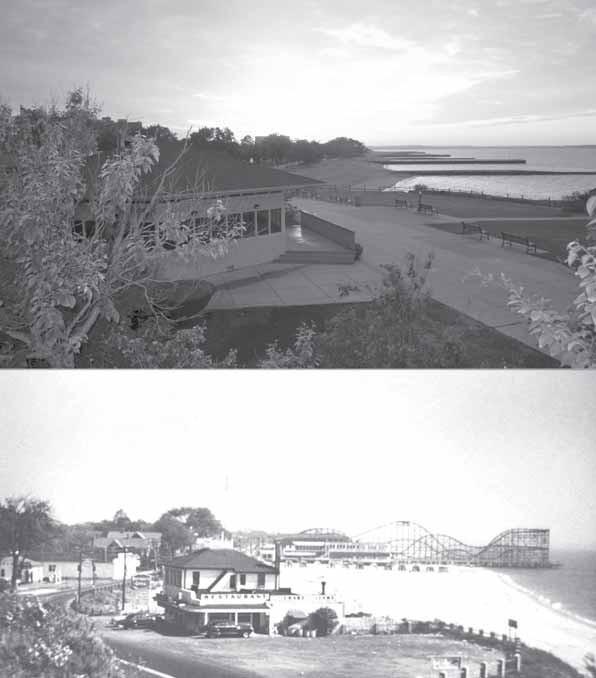
On July 5, 1984, the Bradley Point Veterans Memorial Park and the Soderman Flagpole were dedicated. The event took place exactly 205 years after the British invasion of New Haven landed at Bradley Point, as is noted on the bronze plaque near the flagpole, and was so nobly resisted that day by West Haven Minutemen. The Flagpole was dedicated to William Soderman, who received the Congressional Medal of Honor from President Truman – the only resident of West Haven ever to be so honored.
The success of the park and the walkway along the shore was immediate and overwhelming. After having again unsuccessfully resubmitted the “Great Wall of China” proposal for Parcel I in the early 1980’s, Summerset Ltd. finally in 1987, agreed to sell their development rights to the City for $2.5 million. The park plan was approved in 1989. Today the beautiful “Grove Park,” where the Savin Rock Festival has been held ever since, beckons West Haveners to its pavilion and tree-lined walkways. No 12 story 800+ foot long apartment building, that would have forever blocked West Haveners from their beautiful Shoreline, stands there today.
In 1988 and early 1989 Mayor Guerra worked to attempt to secure the remaining parcels of the 40 acres that people in West Haven so fervently wished to be saved.
The work of the City was aided by two very important factors: 1) the value of the Condo market began collapsing in 1988. The developers (Jimmies and the former Casino owners) wanted $25,000,000 for the development rights. But the other factor was 2) retired former Supreme Court Justice Santanello was a master arbitrator, and as the condominium market continued to plummet in price, he continued to negotiate the developers down to $7 million. The necessary City boards approved the bonds that purchased all the remaining parcel’s development rights in April, 1989. There was opposition. Some in IMPACT opposed the purchase as still too expensive and even wanted to tear down the Casino building – that became the Savin Rock Conference Center.
In June of 1989, Mayor Guerra appointed the “Parcel J1, L and M Committee” with Judge Michael Heffernan as chairman. It was tasked with making recommendations for the Casino and other parcels. Mike had been Summersett’s attorney, but now realized how important saving the shore was to West Haven. Steve Hildrich of the 1979 Concerned Citizens, which had secured the Compromise plan, was appointed, along with such West Haven luminaries as John Ireland. The Committee took a survey of public opinion and would have recommended including the Parcels into the Park and saving the former Casino building. However, Mayor Evangeliste won the 1989 election and dissolved the Committee in Jan. 1990. Eventually, what is now the wonderful Savin Rock Conference Center and Savin Rock Museum, was created, which enhances the Shoreline so well.
Most importantly, the development rights to all 40 acres Redevelopment Project II were now owned by the city – and thus the people of West Haven – a 20-year struggle. However, many were concerned that some West Haven administration might somehow be able to sell off some of the shoreline parcels to developers. A land trust was mentioned but no one took action.
In early 1991, Mayor Evangeliste even talked of it, [perhaps] not realizing that the City could not have a Land Trust over its own property. Any lawyer or any intelligent person could have founded a land trust, but only one person did.
Encouraged by the Historical Society also in very early 1991, Steve Hildrich agreed to found a land trust. With suggested names from Historian Harriet North, he formed the Land Trust of West Haven committee and prepared the Articles of Incorporation and Bylaws. At meetings with the public and in newspapers, Hildrich, as founder and Acting Chairman, explained how the Land Trust would have to pressure and negotiate with the City to grant it a “Conservation Easement” which would give the land trust the legal right to prevent development of the 40 acres of shoreline.
However soon after his documents were filed with the Secretary of the State, incorporating it as the Land Trust of West Haven, Inc., Hildrich had a falling out with his erstwhile supporters from the Historical Society. To him, they wanted to make it more a political tool to attack the Mayor. Hildrich resigned in late May of 1991, when the land trust board elected Ted Adams as Chairman.
A final delay occurred when Superior Court Judge Booth decided that the land trust could not have a binding conservation easement over the shoreline, until the expiration, in 2006, of the 40 year Federal Redevelopment Statute. Adams died about 2006 and had been succeeded earlier as President. After extended negotiation, the Conservation Easement was signed by the City and the Land Trust in 2007, ending the 40 year struggle to save the West Haven shore.