By Dan Shine
Voice Columnist
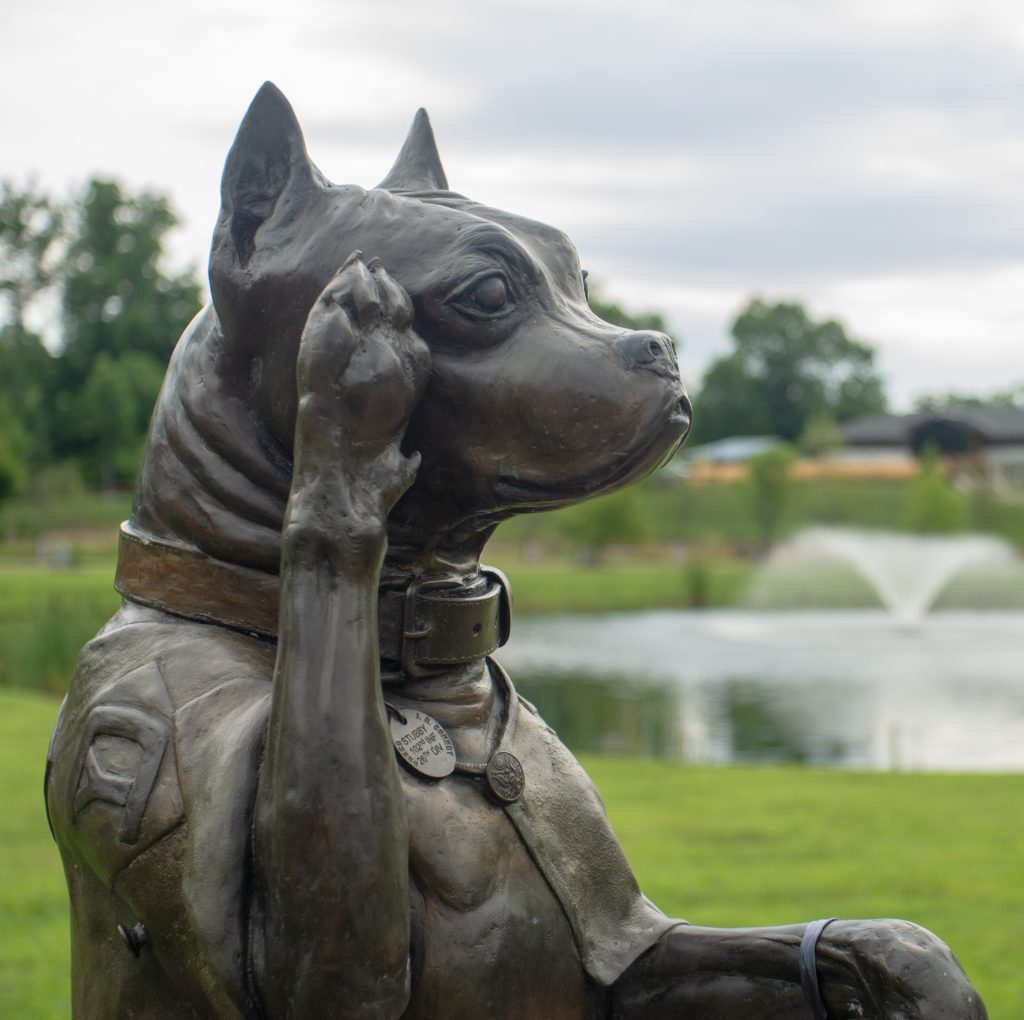
Sergeant Stubby, War Dog
On July 18, 1914, World War I, also known as “The Great War” began. The warring parties consisted of The Central Powers (Germany, Austria, Hungary, Ottoman Empire and Bulgaria) against The Allied Powers (France, Great Britain, Russia, Italy and Japan). The United States entered the war on behalf of The Allied Powers on April 6, 1917. Our troops entered the war in June of 1917, and the war was concluded on November 11, 1918. It was a costly war for all participants including the United States, who suffered 116,000 deaths from actual combat wounds as well as from combat related illnesses.
Among the warfighters sent to France were the men of the 102nd Infantry Regiment, organized under the 26th “Yankee Division.” Pending their deployment, they were gathered together at Camp Yale in an encampment of pyramidal tents along Derby Avenue and Central Avenue, next to what then was the brand-new Yale Bowl. There they trained in preparation for their deployment to France.
And this is where our story begins.
One day, a stray and hungry little Bull Terrier pup wandered into camp, looking for food, and took the first steps toward becoming a doggie legend. He would remain with the troops for the rest of the war: From the start, the men would generously share their rations with him—this meant that he could count on about ten little meals per day!
Since the stray was becoming a mascot, and since the men had spare time between drills and meals, they taught him how to salute! His presence was expressly forbidden by a “no dogs allowed” order, but when apprehended, he would use his saluting trick to disarm any officer who found hm in violation of the regulations.
By now, the pup had a name, and it was Stubby, in recognition of his short tail. As the men were moved out of Camp Yale and boarded a ship, Stubby was smuggled aboard under the overcoat of Private Robert Conroy of New Britain, Connecticut. The smuggler and his dog were discovered, but once again Stubby’s salute worked to his benefit.
Shortly after they arrived in France and were committed to battle, Stubby was injured in a gas attack. Following his rehabilitation, Stubby was returned to service with a custom-made gas mask. He had, due to his injury, learned to recognize the onset of a gas attack, and because of this, he would warn the soldiers and in so doing, he saved lives. Because of his superior hearing, Stubby could also warn the soldiers of enemy soldiers who were approaching by stealth.
In recognition of Stubby’s contributions to the war effort, he became the first War Dog to be promoted to the rank of Sergeant.
During the Battle of Seicheprey, Stubby received a shrapnel wound. While he was hospitalized and convalescing, Stubby lifted the spirits of the wounded soldiers as they recovered. After the Battle of Chateau Thierry, local women made him a chamois jacked, embroidered with the flags of the Allies, plus his medals and a wound stripe. He continued to add to his legendary achievements by capturing an enemy soldier and holding him captive by the seat of his pants until help arrived!
By the end of the war, Sergeant Stubby had received several wounds and had become the kind of legendary figure whose efforts and achievements carry on, long after they are gone. He traveled about the U.S. and eventually met three presidents and many dignitaries. Sergeant Stubby died peacefully in 1926, and his preserved body is on display at the Smithsonian Institution in Washington D.C. A replica of this display may be found at The West Haven Veterans Museum and Learning Center,30 Hood Terrace, open Thursday, Friday and Saturday, 10-2. Telephone (203) 934-1111.
Note for bronze statue photo: The Sergeant Stubby bronze statue is located in the Connecticut Trees of Honor Memorial near the Veterans Memorial Park in Middletown.
This article reminds me of the dog we adopted in Vietnam. His name was Cu Chi because that is where we found him wondering & hungry. Since we were coming into basecamp from the field, we were able to always have some of us take care of “Cu Chi” & feed him.